

What is QD-OLED? Samsung's next-gen TV display explained
What is QD-OLED? Samsung's side by side-gen Television set display explained
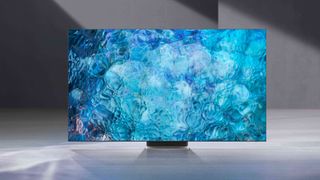
It might be tempting to dismiss Samsung'south QD-OLED hybrid brandish technology and as marketing spin. After all, TV makers are always on the lookout for the next big matter, whether it's higher resolution, new smart features, or more transparent gimmicks, similar 3D TVs and curved screens. Whatsoever gets TV shoppers buying new TVs, some TV maker will latch onto it.
Simply Samsung has recently been investing heavily in new Boob tube technologies, developing ways to make TVs better, and non just more than marketable. In contempo years, it'southward been the introduction of the offset 8K TVs and the development of micro-LED displays. And while these are even so unproven, forward-looking technologies, Samsung hasn't stopped there. That brings u.s.a. to QD-OLED, which combines aspects of both Samsung QLED TVs and the OLED displays used by competitors like LG and Sony.
- All-time Samsung TVs
- Our guide on how to employ your Samsung Television set
- Best OLED TVs
The resulting QD-OLED applied science promises big things for the TV world, and rumors have started swirling that Samsung'due south kickoff QD-OLED TV could arrive as early on as next twelvemonth. We've had our eye on the new technology for some time — I first wrote most it back in 2019 — but it's looking similar Samsung is endmost in on the first QD-OLED TVs.
At CES 2022, nosotros likewise got a experience for how Samsung's new QD-OLED displays could shape the upcoming TVs of the year.
So, for anyone else that's waiting for the hybrid TVs as eagerly as we are, here's everything we know so far well-nigh Samsung'due south game-changing QD-OLED TVs.
What is QD-OLED?
QD-OLED is a hybrid technology that combines quantum dots and OLED panels. Past combining the ii technologies, Samsung is hoping to crack the code for perfect displays.
The ideal for modern motion picture quality would combine brilliant colour, true blacks and loftier brightness without any haloing. Current OLED technology handles blackness levels and pixel-perfect illumination better than any other technology, but information technology struggles to deliver the brightness and life-like color that LCD panels produce. QLED TVs, on the other manus, can bulldoze powerful backlights for unbeatable brightness and superb color, only without OLED's per-pixel illumination, backlighting volition always exist less controlled.
Samsung has been developing the engineering science for years, just has not yet appear any products featuring the new applied science. However, industry reports suggest that the first Samsung QD-OLED TVs could launch as soon equally next leap.
How does QD-OLED work?
Samsung's hybrid QD-OLED technology combines the all-time aspects of two major innovations in display technology, pairing the crispness and pixel-perfect dissimilarity of OLED with the boosted brightness and expanded color that quantum-dot engineering delivers. The effect is a best-of-both-worlds brandish that offers the impeccable quality of OLED without sacrificing the superior brightness and color that QLED TVs offer.
To understand how that will piece of work, we need to look at each technology individually.
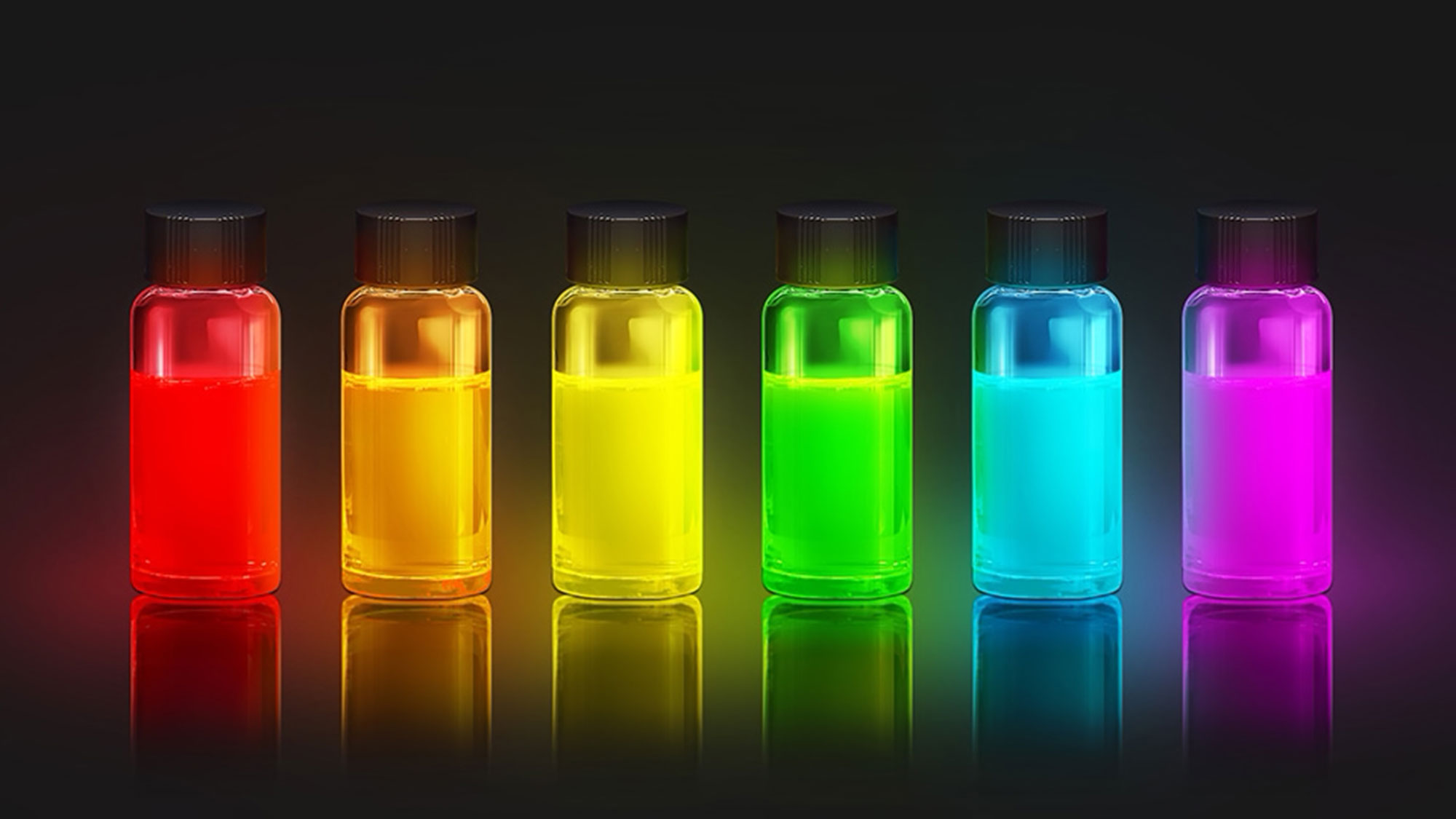
How QLED works
Quantum dot technology uses microscopic crystals that have the curious holding of glowing nether certain wavelengths of light, emitting their own lite at certain wavelengths. They too function as semiconductors, so they can be individually turned on and off. When paired with a separate lite source — the LED in QLED refers to the TV'southward LED backlight — these niggling nanometer-sized crystals not only glow, they produce color based on the size of the crystal.
Samsung has harnessed these glowing quantum dots to create TVs with better color and brightness than a traditional LCD panel can provide, and the engineering has since been adopted past other manufacturers. By combining these color boosting quantum dots with a standard LCD console and specialized colour filters, QLED TVs can evangelize the best brightness and nigh vivid colors bachelor in modern TVs.
And don't expect traditional quantum-dot displays to go anywhere just because Samsung is cooking up something new. Samsung's QLED TV line will likely be around for years to come, and competitors like TCL, Hisense and Vizio have all adopted similar breakthrough-dot enhancement for their own TVs. (Check out the all-time QLED TVs for our favorites.)
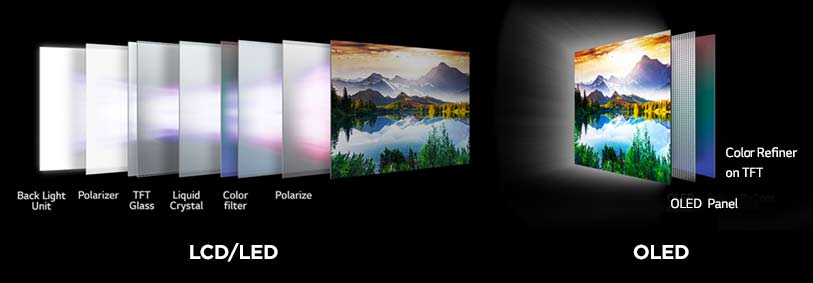
How OLED works
OLED uses organic compounds – electroluminescent materials similar organometallic chelates, p-phenylene vinylene and Due north-vinylcarbazole, not biological material – that light upwardly individual pixels. These compounds tin can be printed straight onto glass, assuasive for the thinnest Telly screens available.
But inkjet printing exotic compounds to create the millions of pixels used on a single TV is difficult — difficult enough that LG has faced very niggling contest in manufacturing TV-sized OLED panels. Fifty-fifty competitors similar Sony and Vizio use LG panels for their ain OLED TVs. That makes LG's OLED technology the de facto standard, and whatever improvement Samsung tin offer volition effectively leapfrog the entire OLED Boob tube industry.
LG'south OLED technology is technically called WRGB OLED, because information technology uses white OLED as the principal light source, with additional color filtering that adds ruddy, greenish and blue to each pixel. Because each pixel's light source can exist turned on and off, this allows OLED TVs to deliver true black, and to illuminate simply the pixels that are supposed to be lit. As a result, OLED has consistently delivered the best picture quality in modernistic TVs.
However, considering the TV uses those self-lit pixels instead of a powerful backlight, the brightness is limited to what the OLED white pixel can produce, and non all of that light is projected forward toward the viewer. The perceived effulgence is then further limited by the addition of the color filters that give each pixel its color. That results in dimming, and less vibrant color overall.
LG and other manufacturers have been working to improve OLED brightness by adding additional elements to the pixel construction, and past driving the white pixels harder to evangelize better brightness, simply those fixes often upshot in shorter lived displays, and increment the risk of burn down-in.
The best of both worlds: QD-OLED
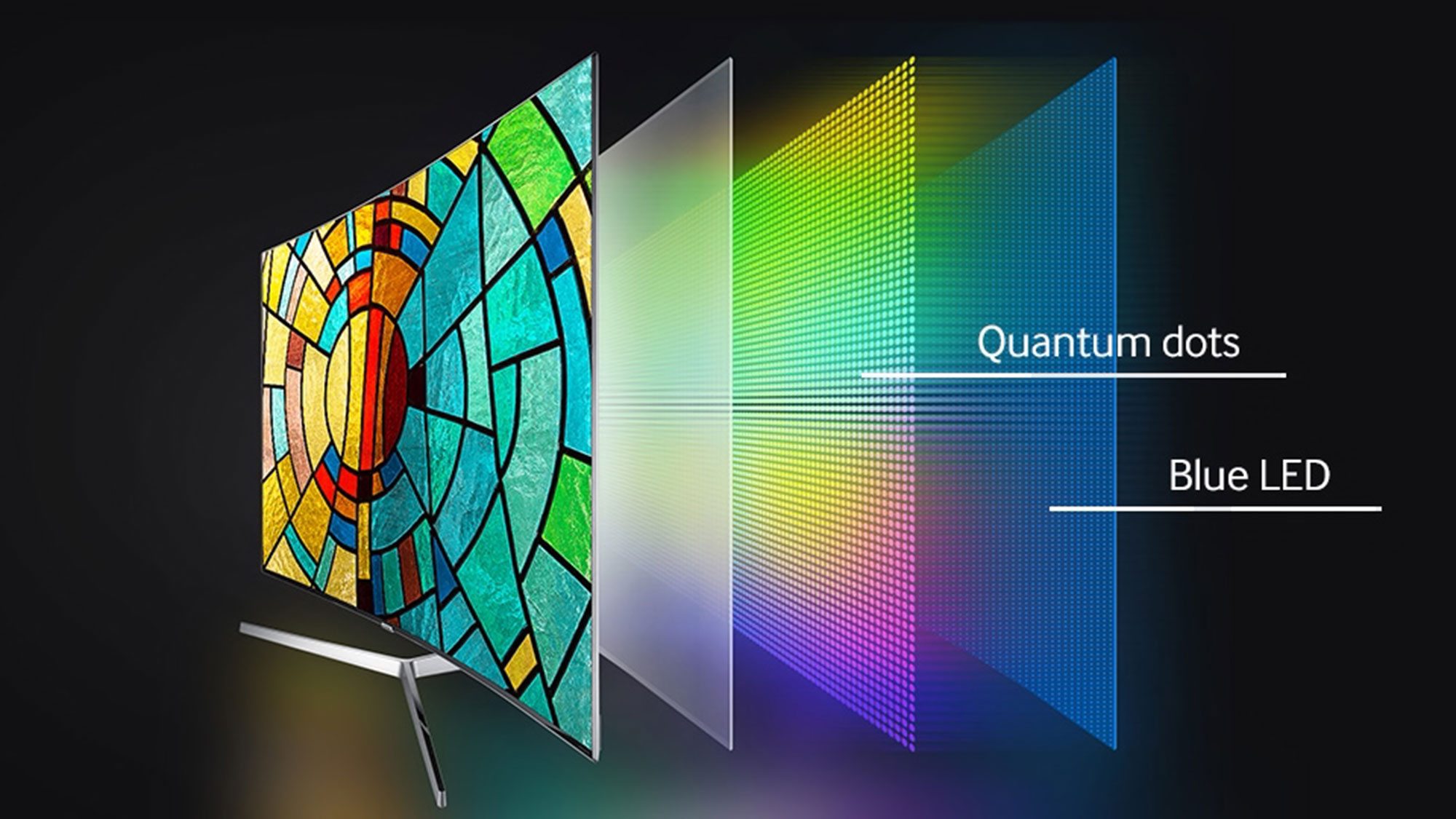
By pairing the per-pixel control of OLED with the light- and colour-boosting qualities of breakthrough dots, Samsung is hoping to get the best qualities of these two leading TV technologies.
From what's known about Samsung's hybrid technology, QD-OLED uses blue OLED emitters instead of white, but instead of filtering that light to create colors, information technology uses information technology to trigger the vivid glow of quantum dots to generate the different colors that make up individual pixels. The combination of the two should evangelize amazing brightness without the inefficiencies of electric current WRGB OLED.
The resulting displays are also expected to exist thinner than any current QLED or LCD panel, but slightly thicker than current OLED, since it does crave that extra layer of quantum dots.
What are the benefits of QD-OLED?
Non only does QD-OLED engineering science promise to deliver potentially the best picture quality of modernistic TVs, in that location are other huge benefits that could come up from the new type of displays.
Kickoff, the additional brightness offered past QD-OLED could result in more efficient displays, giving you a TV with a better movie, merely besides 1 that uses less power.
Quantum dots also aren't prone to the same burn-in issues that the organic compounds of OLED are, making for displays that terminal years longer than electric current OLED models.
The new applied science could too come in at a lower price than traditional OLED panels, which are among the most expensive in the Telly category. Still, the first round of QD-OLED TVs will surely exist expensive – new technologies toll more than to produce, initially, and it'due south not unlikely that the first Samsung QD-OLED TVs will price as much or more than than Samsung's pricey 8K TV line.
But OLED prices have dropped considerably over the eight years since the commencement OLED TV sold for nearly $x,000. With current meridian picks like the 65-inch LG G1 OLED selling for $2,499, that's a 75% drop in less than a decade, and you'll still go LG'due south best OLED Tv set. With the addition of some existent contest from a major player similar Samsung, prices of both OLED and QD-OLED should drop even more.
When will we encounter QD-OLED TVs?
According to a recent report from Republic of korea'due south The Korea Economic Daily, Samsung is prepping the offset of its new QD-OLED TVs for the first half of 2022. According to industry sources, the report suggests that 55- and 65-inch models will come up kickoff, with a 70-inch selection coming after in the year.
If in that location's anything to this rumor, we suspect that Samsung volition be formally announcing the first QD-OLED TVs during CES 2022, which takes identify just later the new yr. The bear witness has been a popular consequence for major product announcements, including Samsung'due south biggest reveals of the last several years, from the get-go 8K and MicroLED TVs to the latest Neo QLED models.
If past product launches are whatsoever indicator, nosotros would expect the announcement to exist followed up by the new QD-OLED sets going on sale in March or April of 2022, merely new technologies don't ever follow the standard launch cycle for mainstream TVs.
What will QD-OLED TVs be called?
The term QD-OLED has been the principal ane used for the new display engineering science over the last few years, but information technology's unlikely that Samsung will use that in the name. Much like Samsung'due south Neo QLED TVs, which added mini-LED backlight to existing QLED technology, Samsung will likely apply a new, easily trademarked name for the technology.
Recent material from Samsung Brandish — the portion of Samsung that makes the panels that volition be used in TVs, which come up from Samsung Electronics — uses the term "QD brandish" instead of QD-OLED. It's possible that Samsung Electronics will use the aforementioned term in its branding, merely probably not.
That's all a long way of saying that we may not learn what Samsung is going to telephone call the new QD-OLED TVs until the company makes an official announcement, or perhaps leaks the news early. (We'll be there to cover it either way.)
What volition QD-OLED TVs price?
Returning to the recent study from Due south Korea's The Korea Economic Daily, Samsung is planning to position the new QD-OLED TVs "between its peak-premium segment of MicroLED TVs and its flagship QLED lines."
That's a pretty wide range of prices, from tens of thousands of dollars for the MicroLED, and the Editor'due south Pick Samsung Neo QLED QN90A, the tiptop 4K model, which starts at $i,799 for the 55-inch model.
It's obviously hard to pin downward something that ranges from $1,799 to $99,999, but I think information technology more likely that QD-OLED would fall a little north of what Samsung charges for its top 8K Neo QLED ready, which sells for $iii,999 for the 65-inch model.
All told, I'd await something around $v,000 for the 55-inch model, and $six,000 for the 65-inch version. Time volition tell if nosotros're right, but we'll update this whenever pricing information is announced.
Is anyone else making QD-OLED?
While Samsung has thrown its money and resources into developing QD-OLED technology, it'south not the only player in the Television set world that'southward looking to combine OLED and quantum dots.
Reports from OLED-info.com propose that Chinese manufacturer TCL is hard at work on what it calls H-OLED, which also would use a blue OLED emitter layer with red and green quantum dots on meridian to bang-up multicolored pixels, similar in many respects to what nosotros know virtually Samsung'due south technology.

Source: https://www.tomsguide.com/news/what-is-qd-oled-samsungs-next-gen-tv-display-explained
Posted by: beahmprothervents.blogspot.com
0 Response to "What is QD-OLED? Samsung's next-gen TV display explained"
Post a Comment